
Case Study
Building High-Trust Leadership: A Semiconductor Offsite
We brought the executive team of a major semiconductor company together to look honestly at how they work. By applying Lencioni’s Five Dysfunctions framework, we gave them the space to have candid, necessary conversations around trust and accountability, turning friction into clear leadership commitments.
- Format
- Full-day
- Audience
- Senior Global Executive Team
- Industry
- Semiconductor

Client Overview
The client is a global semiconductor technology company operating at the forefront of advanced materials and manufacturing innovation, with teams and operations spanning multiple continents. Its senior executive team of eleven leaders steers the company’s global operations — and recognised that the way they work together at the top would set the tone for performance and culture across the wider organisation.
The Challenge
As a newly focused leadership group, most of the team had never experienced a structured team development session before. The leadership commissioned a bespoke full-day offsite with a clear ambition: build a shared framework for high performance, strengthen psychological safety and openness, establish healthy norms for conflict and peer accountability, and align the group around collective rather than individual results.
Our Approach
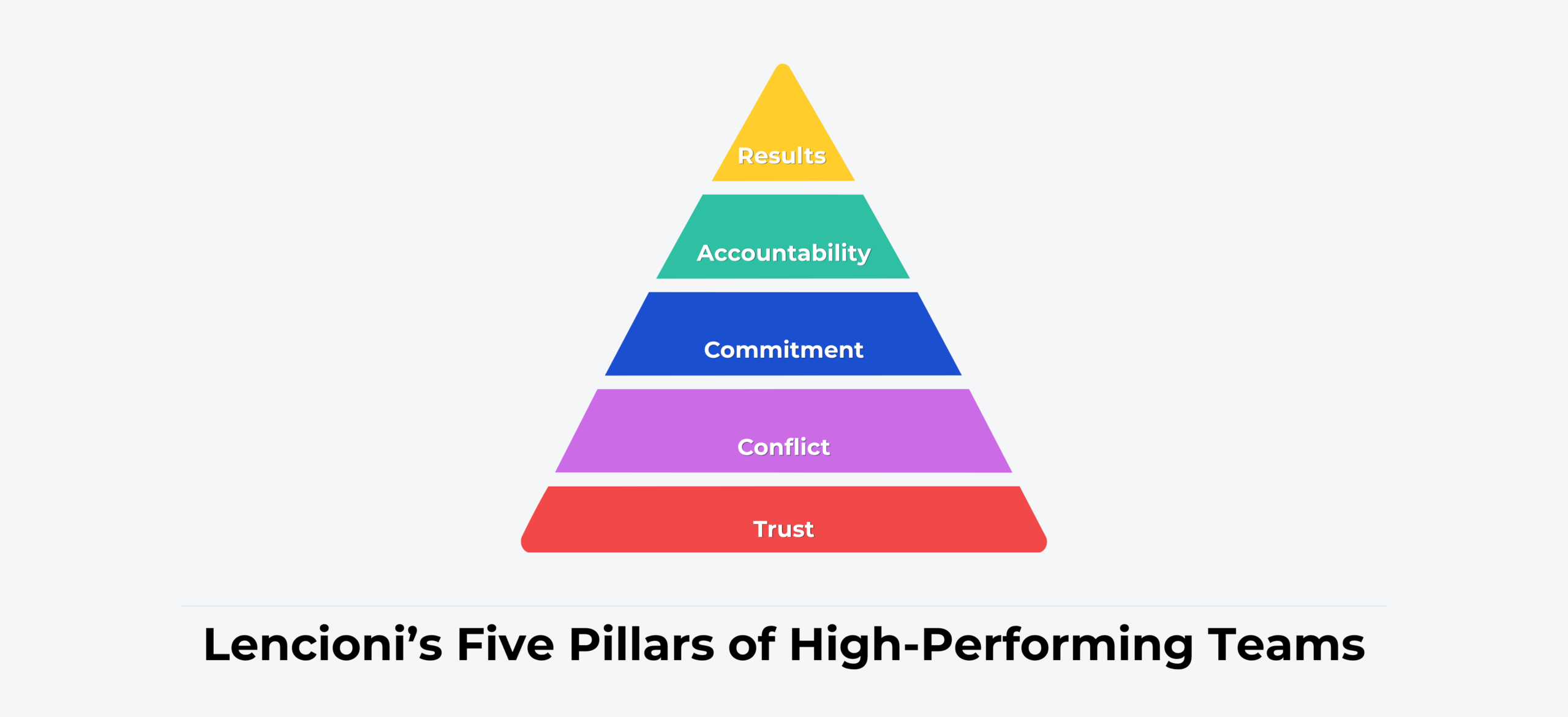
We designed a progressive, experience-based full-day offsite around Patrick Lencioni’s Five Pillars of High-Performing Teams: trust, conflict, commitment, accountability, and results — with each pillar building on the last, and every conversation grounded in the team’s own assessment data rather than abstract theory.
Pre-Workshop Team Assessment
Ahead of the session, all eleven leaders completed a 37-question survey based on The Five Dysfunctions of a Team. The results were revealed live during the workshop and used as real data to ground every conversation in the team’s actual experience — making the day about them, not a generic model.
Vulnerability-Based Trust
Through a foundation reflection on what high performance means to each leader, personal histories sharing, and vulnerability-based trust exercises, the team began openly acknowledging strengths, weaknesses, and mistakes — directly addressing their lowest-scoring area and reducing the attribution errors that quietly erode senior teams.
Healthy Conflict & Constructive Feedback
Using the Thomas-Kilmann Conflict Mode Instrument, leaders mapped their natural conflict styles and explored when each style helps or hurts. The team then practised demanding and delivering constructive feedback using the SBI (Situation–Behaviour–Impact) model — reframing conflict as tension in pursuit of the best idea, not combat.
Commitment, Accountability & Rules of Engagement
The day closed with commitment clarification — every meeting ending with a clear decision, clear action, and a unified message to cascade — each leader making a named commitment to the group, and the team agreeing their first Rules of Engagement: the starting point of a team playbook, with follow-up actions embedded into their next team meeting and a three-month check-in scheduled.
Result & Impact
A Shared Language for High Performance
The team left with a common framework — Lencioni’s five pillars — that they can reference and build on well beyond the offsite, alongside their own assessment results, conflict profiles, and Rules of Engagement kept visible and active in day-to-day operations.
Conflict Reframed as a Source of Growth
The conflict management work was consistently cited as the most valuable part of the day — described by participants as clear, practical, and directly applicable to the real challenges the team is facing. Leaders now share an understanding of one another’s conflict styles and agreed norms for engaging in healthy debate.
A Feedback Culture Taking Root
Candid, structured feedback — including openly demanding feedback from peers — moved from uncomfortable territory to a practised skill. The SBI model gave the team a simple, repeatable mechanism for offering constructive feedback, directly targeting one of the assessment’s weakest behaviours.
Commitments the Team Owns Together
Every leader left with a named commitment to the group. Participants were so energised by the experience that several called for the programme to be extended more broadly across the organisation.
Participant Feedback
The conflict management approach was very clear and applicable to the challenges we are currently facing.