
Case Study
Facilitating Sensitive Topics in Higher Education
How we equipped higher ed educators with practical facilitation tools, ORID techniques, and scenario practice for managing sensitive classroom topics.
- Format
- Half-day
- Audience
- College Lecturers
- Industry
- Education

Client Overview
The client is a prominent public vocational institute with a diverse student population. While technical coursework is their primary focus, the institute recognised that its lecturers frequently face delicate, real-world classroom discussions. To support their team, they looked for hands-on facilitation training that gives educators the confidence to guide hard conversations effectively.
The Challenge
Lecturers at the institute faced an increasing challenge: managing classroom discussions around sensitive issues like race, religion, digital ethics, and mental wellness. They needed practical facilitation techniques to keep debates respectful, encourage quiet voices, and defuse tension when conversations got heated. The institute commissioned a practical half-day training workshop to give these educators immediate, scenario-based practice handling tough classroom dynamics.
Our Approach
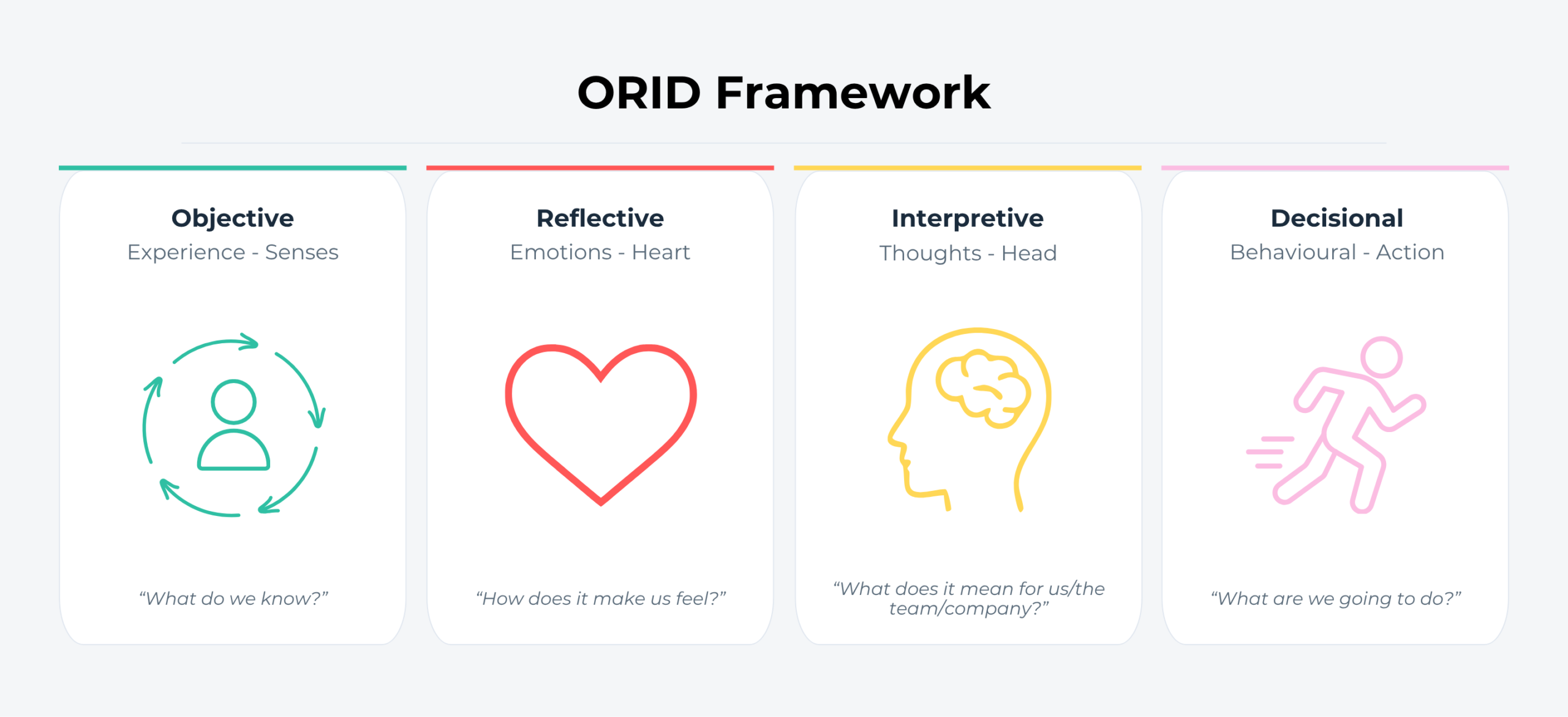
To address these challenges, we delivered a practical four-hour facilitation workshop that moved educators straight from core principles into active practice. The foundation of the training was the ORID framework - a structured four-stage conversation method (Objective, Reflective, Interpretive, Decisional) that helps lecturers navigate complex student dialogues with clarity, maintain boundaries, and reach clear learning outcomes.
Foundations
After a relational icebreaker, the group explored the shift from “Sage on the Stage” to “Guide on the Side” and was introduced to the ORID framework. A live poll surfaced the room’s top concerns: mental wellness and interpersonal boundaries, which became the data-driven focus for the rest of the session.
Creating the “Brave Space”
The group moved from the idea of a “Safe Space” to a “Brave Space” — co-creating ground rules for navigating discomfort with mutual respect — before building their core toolkit: the power of neutrality, active paraphrasing that reflects both content and emotion, and probing questions that open up dialogue instead of leading questions that shut it down.
Practice
Lecturers worked through two live scenario walkthroughs — responding to a student’s mental wellness disclosure with acknowledgement, referral, and refocus, and managing boundary-violating “hot moments” using the “Pause, Acknowledge, Re-set” technique. In small groups, they then designed and ran their own 15-minute facilitated discussion of a realistic classroom case using the ORID framework.
Walking Debate
A 1-2-4-All debrief drew out the collective insights from the practice round, followed by a live “Walking Debate” demonstration for safely engaging an entire room on divisive topics. Each lecturer left with a digital takeaway resource, probing question banks and a personal commitment to one technique and one ground rule to apply within two weeks.
Result & Impact
100% Satisfaction Rate
Every participant rated the workshop 5 out of 5, giving unanimous top marks to the facilitator for her steady, grounded approach, crystal-clear delivery, and deep expertise in handling complex classroom dynamics.
Greater Confidence with Sensitive Topics
The overwhelming majority of lecturers reported feeling significantly better equipped to lead sensitive classroom discussions.
Practical Over Theoretical
Lecturers singled out four key tools as their most valuable takeaways: the ORID framework, Brave Space norms, role-play simulations, and the Walking Debate. Their feedback was consistent: these were concrete, usable tools for real classroom moments, not abstract theory
Appetite to Go Deeper
When a four-hour workshop ends with participants asking for a full-day version, you know the material resonated. Lecturers asked for even more scenario practice and case studies, confirming that the tools were practical enough to warrant a broader rollout.
Participant Feedback
Clear, concise, and simple to understand. The facilitator is very experienced, confident, and well-versed in her content, and answers questions very well.