
Case Study
Lunch & Learn Series for a Global Law Firm
We brought together the Singapore business support team of a global law firm to sharpen how they collaborate. By combining hands-on team challenges with the Thomas-Kilmann conflict model and a practical de-escalation toolkit, we helped them turn daily friction into constructive teamwork.
- Format
- Lunch & Learn
- Audience
- Business Support Professionals
- Industry
- Legal Services

Client Overview
The client is the Singapore office of a leading international law firm. Its business support professionals — legal secretaries and teams from across operational functions — are the connective tissue of the practice: coordinating across departments, managing competing priorities, and supporting legal and business needs under constant time pressure. That makes trust, clear communication, and conflict management central to their effectiveness.
The Challenge
The firm wanted to invest in the people who keep its operations running. What began as a session planned for a small group of legal secretaries grew into a two-day series for a broader group of around twenty business support professionals. The brief was clear: build a stronger sense of team spirit and collaboration, improve the team’s ability to manage and resolve conflicts constructively, and sharpen everyone’s focus on shared organisational priorities over personal differences — all delivered in compact two-hour lunchtime sessions that respected demanding workdays.
Our Approach
We designed a two-part arc: Day 1 built connection and revealed what great teamwork looks like in action; Day 2 turned that foundation into practical conflict resolution skills, pressure-tested through realistic scenarios drawn from their daily work.
Connection & Collaboration in Action
After a lively Human Bingo icebreaker, teams tackled a jigsaw puzzle challenge with a twist: no table held all the pieces they needed. Completing the puzzle required reaching out, negotiating, and bridging gaps with other tables — a direct mirror of the cross-departmental coordination their roles demand every day.
The Ideal Team Player
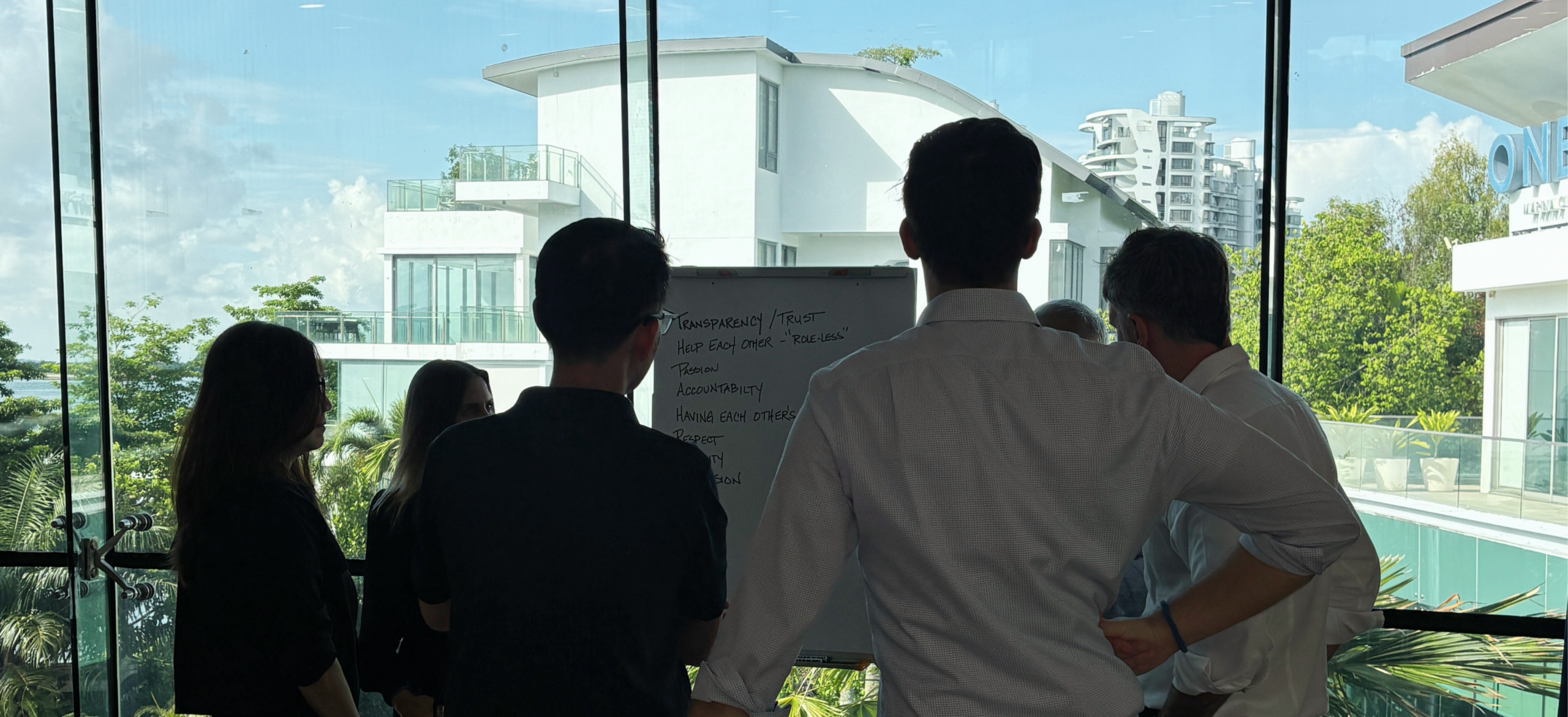
An appreciation round had every participant give and receive specific, genuine recognition from a colleague, followed by a group reflection that surfaced the team’s own definition of an effective team player — qualities like communication, proactiveness, empathy, and reliability.
Conflict Styles Self-Awareness
Using the Thomas-Kilmann Conflict Model, participants identified their default conflict style — Avoid, Compete, Compromise, Accommodate, or Collaborate — and discussed the pros and cons of each style in the context of the firm’s deadline-driven environment, building the situational awareness to flex between styles.
De-escalation Toolkit
A hands-on building challenge with deliberately injected mini-conflicts — resource disputes, shrinking deadlines — let the team observe friction as it emerged. We then equipped them with a de-escalation toolkit: the Six Seconds Model (Pause, Reflect, Act), curiosity questions and “we” statements, and a Three-Step Conflict Resolution Model (Listen, Acknowledge, Problem-Solve), applied immediately in role-plays of real workplace scenarios such as urgent request overloads and ambiguous email tone.
Result & Impact
Stronger Connection Across the Team
Participants reported a greater appreciation for their teammates and a stronger sense of belonging — with feedback repeatedly highlighting the honesty, openness, and getting to know one another that the sessions unlocked.
Greater Confidence in Handling Conflict
The large majority of participants agreed or strongly agreed that they left feeling more confident and equipped to handle conflicts constructively, with a shared language — conflict styles, de-escalation steps — they can now use with each other.
A Near-Unanimous Top-Rated Experience
Almost every participant rated the overall two-day experience 5 out of 5, with equally high marks for the facilitator — described by one participant as the best communicator and facilitator they’d worked with.
Realistic, Immediately Applicable Content
Participants singled out how realistic and easy to understand the activities and topics were — scenarios built from their actual working life — and asked for even deeper dives into complex communication next time: a clear signal the content struck home.
Participant Feedback
Daria is the best communicator and facilitator — I would love to have her around wherever I go!